Tempting Shortcuts You Do Not Want Your Landscaper to Take
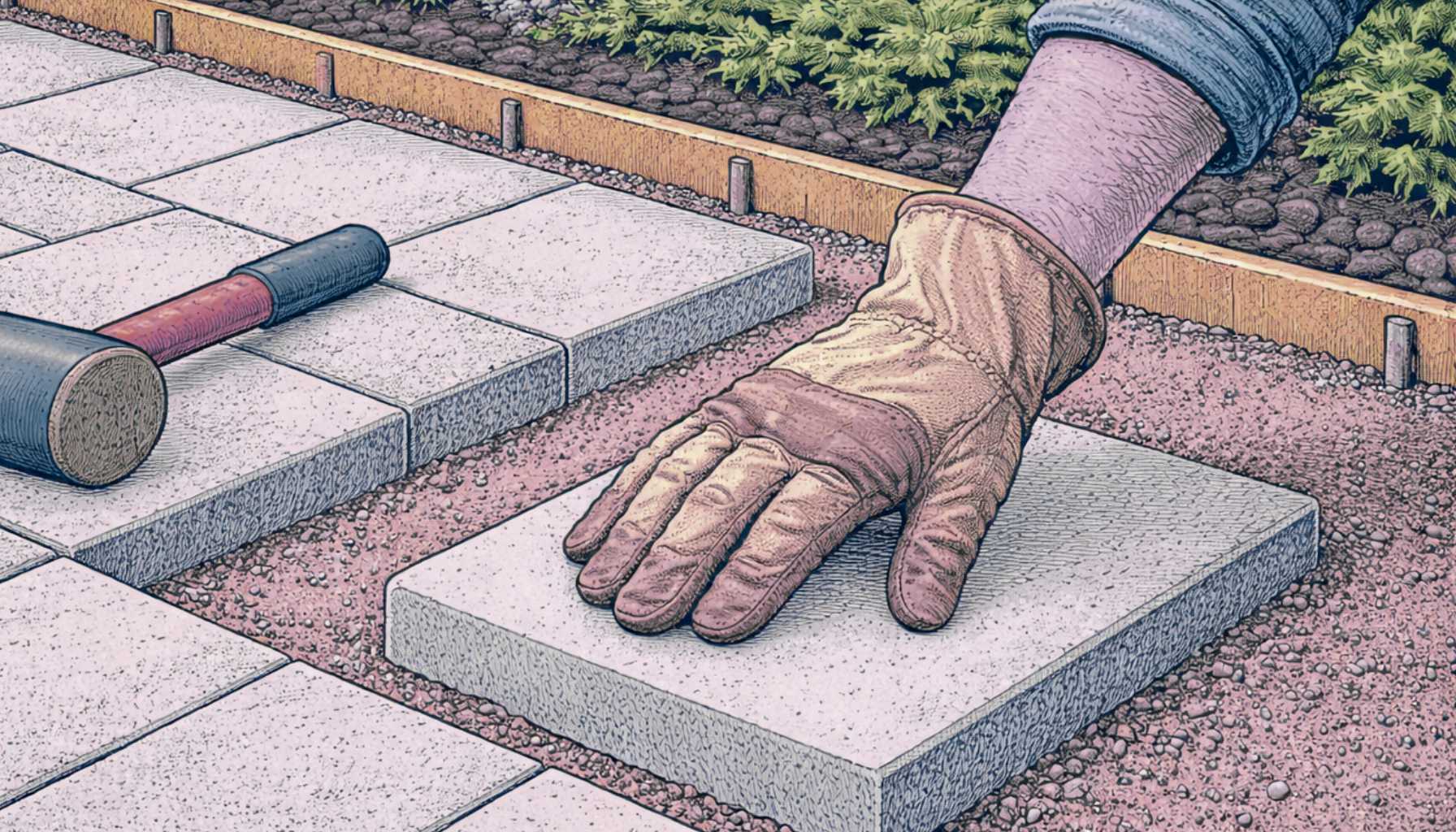
Every patio we build is judged by the appearance of the pavers on the surface, but it is everything below the surface that truly determines the quality of the patio.
New landscapers and DIYers are often tempted to hurry through the prep process in order to get to the really satisfying work of installing pavers. That is a recipe for disaster!
At every stage in the process, there are opportunities for shortcuts, but these are also opportunities to slow down and work carefully to ensure the highest quality.
Common excavation shortcuts
At the excavation phase, we will use our track loader whenever possible to minimize hand work. One would think that driving a 7000 lb machine back and forth over the work site would guarantee that the subsoil was fully compacted, but this is not always the case. When we follow up with a jumping jack compactor, it inevitably finds some areas that have been poorly compacted. These are often along the edges and in the corners that are less accessible to larger machines. Ensuring proper subsoil compaction reduces future settling that may not show itself until many years in the future.
If we as a landscaping contractor or you as a DIYer skips the use of a jumping jack compactor, it will make no difference in the initial appearance of your patio, but the lack of proper compaction will reveal itself 5 or possibly 10 years in the future when the subsoil settles, causing an uneven surface.
Common stone base shortcuts
Once excavation is complete, we lay out geotextile and start installing the base stone. While our plate compactor is technically capable of compacting 4-inch lifts (layers of stone), we prefer to install the stone in 2 to 3 inch lifts. This guarantees full compaction, without any soft spots. The thinner lifts are easier to compact properly, and even though it requires more lifts to reach our target of 6 to 8 inches of base stone, it does not take any longer to complete.
As with the subsoil compaction, improper compaction of the stone base may not cause problems for several years, but eventually it will.
Refining the grade, opportunities for shortcuts
Once we are within a half inch of the final grade we begin the process of refining the grade. Here we use an assortment of screed boards up to 12 feet long to ensure there are no bumps or dips in the patio. Patios may be screeded and recompacted up to 3 or 4 times to gradually refine the surface.
At this stage it is especially tempting to move on to laying pavers a little too quickly. Our rule is that when the grading is nearly perfect, we screed the entire area one more time to ensure we haven’t missed anything.
Finally, we get to install the pavers
With a near perfect surface on the base stone, it is now time for the most satisfying part of any project, the paver installation. If we have taken sufficient time with all of the prep work, this step moves all too quickly and is as effortless as moving several tons of bricks can be.
We've been landscaping contractors in Winnipeg for 28 years. We guarantee our hardscaping work so we have learned which shortcuts are just not worth it. If you'd like our help installing a patio in Winnipeg, we'd love to do that for you.
We believe that quality landscaping is actually more affordable. If that sounds interesting to you, we'd be happy to give you a very quick and easy preliminary quote. No need for a call or site visit. Just email us with a bit of info.